The Best Scenic Train Rides in the World
Ranked on one question: how much of the journey is what you came for. Vote it into a better order, because the top of this list is a real argument. Two inputs, both from each railway's own record. First, scenic share: a twenty-kilometer line that delivers from the first minute beats a two-day run with one good afternoon in it, so density wins over distance. That tends to favor the shorter rides, though the shortest one here finishes sixteenth. Second, ground no road reaches. That lifts a ride within its band rather than out of one, putting it directly above a comparable neighbor: Durango over White Pass, West Highland over the TranzAlpine. Where two rides are scenic end to end, the order between them is a judgment, not a measurement. Left out: the Venice Simplon-Orient-Express and the Blue Train, whose own accounts are butler service and five-star dining, never a stretch of country. Africa goes unrepresented as a result, and the Alps and Norway take more of the top than a world list should.
Bernina Express is #1 on “The Best Scenic Train Rides in the World”.
- 1
Bernina Express
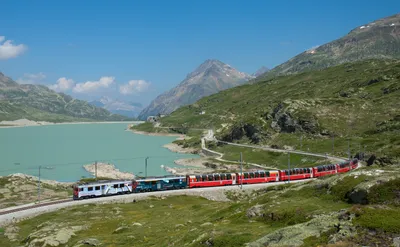
Four hours from Chur to Tirano, run by the Rhaetian Railway for sightseeing rather than transport. UNESCO took the Albula and Bernina lines together in 2008, and the route crosses the Bernina Pass at 2,253 meters. From the summit at Ospizio Bernina it drops about 1,800 meters on gradients of 7 percent, curling right around the spiral Brusio Viaduct near the bottom: a full circle, in the open, the train in sight of itself.
 Bernina Express - Wikipediahttps://en.wikipedia.org/wiki/Bernina_Express
 - 2
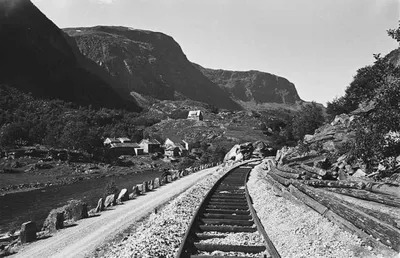
Flåm Line
Myrdal down to Flåm covers 20.2 kilometers and drops 866 meters, at a maximum gradient of 5.5 percent. Construction started in 1924 and the line opened in 1940. Trains pause at Kjosfossen station so passengers can get out and look at the waterfall, a scheduled halt, which tells you what the line is for. Twenty tunnels in twenty kilometers, and each one ends in something.
 Flåm Line - Wikipediahttps://en.wikipedia.org/wiki/Fl%C3%A5m_Line
 - 3
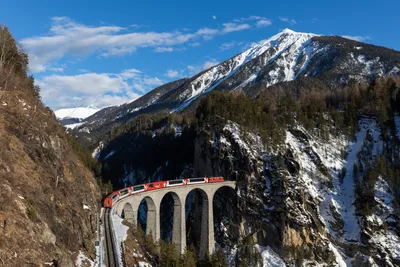
Glacier Express
Zermatt to St. Moritz runs 291 kilometers in about eight hours, over 291 bridges and through 91 tunnels. The first one pulled out of Zermatt at 07:30 on 30 June 1930. Past Filisur, at 1,032 meters, the train swings onto the Landwasser Viaduct, the set piece of the route and the reason people book this direction. Long day. Very little of it flat.
 Glacier Express - Wikipediahttps://en.wikipedia.org/wiki/Glacier_Express
 - 4
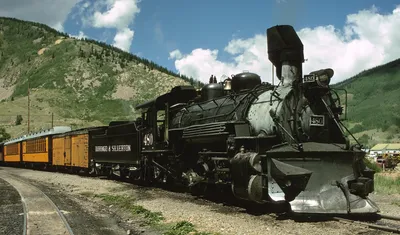
Durango & Silverton Narrow Gauge Railroad
Crews blasted the canyon cliffs off and left a narrow, level shelf to lay the tracks on. That shelf is the ride: the High Line above the Animas River Gorge, with no road within reach of it. The company still runs steam, ten narrow-gauge locomotives with eight of them operational, over 45.2 miles of three-foot gauge in Colorado. Trains have worked this route since 1881, and in winter they turn back at the Cascade Wye.
 Durango and Silverton Narrow Gauge Railroad - Wikipediahttps://en.wikipedia.org/wiki/Durango_and_Silverton_Narrow_Gauge_Railroad
 - 5
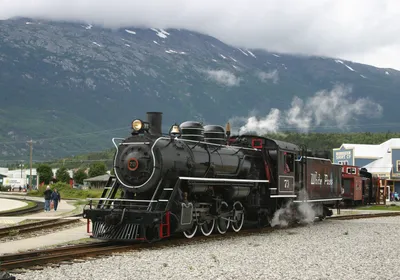
White Pass and Yukon Route
Skagway sits at sea level, and the track climbs to the 2,885-foot summit of White Pass twenty miles out, which builders reached by mid-February 1899. The full narrow-gauge route to Whitehorse opened in 1900, and in 1994 the American and Canadian civil engineering societies named it an international historic civil engineering landmark. The line closed, then came back in 1988 purely for tourist passenger traffic.
 White Pass and Yukon Route - Wikipediahttps://en.wikipedia.org/wiki/White_Pass_and_Yukon_Route
 - 6
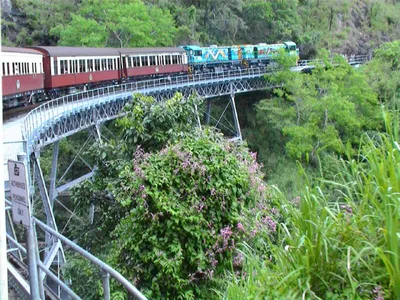
Kuranda Scenic Railway
Fifteen hand-made tunnels and 37 bridges lie between Cairns and Kuranda, and the service takes an hour and 55 minutes to work through them, climbing from sea level to 328 meters. Construction began in 1886 and reached Kuranda by 1891, and many people died building those tunnels and bridges. The route crosses Barron Gorge National Park, with Barron Falls at the top and Stoney Creek Falls on the climb up to it.
 Kuranda Scenic Railway - Wikipediahttps://en.wikipedia.org/wiki/Kuranda_Scenic_Railway
 - 7
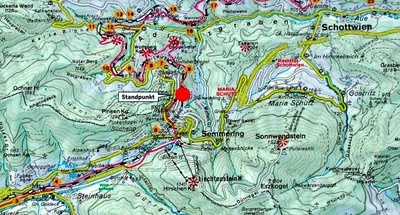
Semmering Railway
Carl von Ghega directed the build between 1848 and 1854 with some 20,000 workers, and what they left is the first mountain railway in Europe laid to standard gauge. Across 41 kilometers it gains 460 meters using 14 tunnels, more than 100 stone arch bridges and 16 viaducts, several of them two-story. UNESCO added it in 1998. The engineering is the view here, because the hills on their own are ordinary.
 Semmering Railway - Wikipediahttps://en.wikipedia.org/wiki/Semmering_railway
 - 8
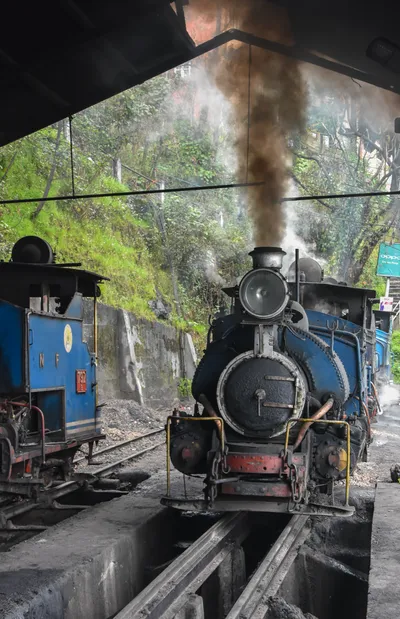
Darjeeling Himalayan Railway
Six zig zags and three loops do the climbing, from about 100 meters above sea level at New Jalpaiguri to about 2,200 at Darjeeling, on 610 mm gauge laid between 1879 and 1881. UNESCO listed it on 5 December 1999. Ghum station sits at 2,258 meters, higher than the terminus, and every steam locomotive currently in use is a B-Class built between 1889 and 1925.
 Darjeeling Himalayan Railway - Wikipediahttps://en.wikipedia.org/wiki/Darjeeling_Himalayan_Railway
 - 9

Rauma Line
An hour and seventeen minutes covers the 114.2 kilometers between Dombås and Åndalsnes, four services a day in each direction. The line opened between 1921 and 1924 as a branch of the Dovre Line and drops 655 meters, using two horseshoe curves to do it. The Kylling Bridge is the one everybody photographs. Best part comes last: Trollveggen and Romsdalshorn, right in the windows.
 Rauma Line - Wikipediahttps://en.wikipedia.org/wiki/Rauma_Line
 - 10
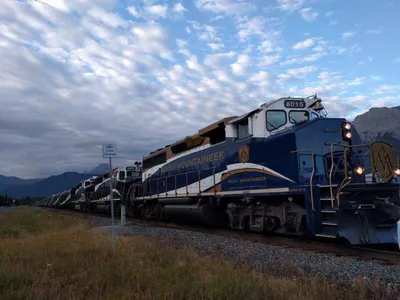
Rocky Mountaineer
Nobody sleeps on board. The service runs in daylight only and puts you in a Kamloops hotel overnight, a scheduling decision made entirely about the view. First Passage to the West goes Vancouver to Banff with a stop at Lake Louise, and the GoldLeaf dome coach is bi-level with full-length windows. It began on 22 May 1988 and runs April to October, so half the year it is not there at all.
 Rocky Mountaineer - Wikipediahttps://en.wikipedia.org/wiki/Rocky_Mountaineer
 - 11
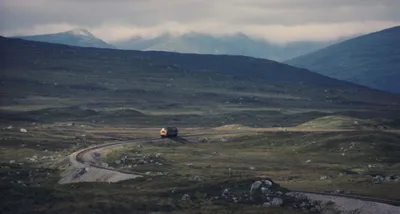
West Highland Line
Getting to Corrour without this line means walking. The station sits out on the moor, one of the most remote in Britain, and no public road reaches it. Craigendoran to Fort William opened on 11 August 1894, and the summit of the line is 1,347 feet. Past Fort William the track crosses the Glenfinnan Viaduct, where West Coast Railways works a steam service called The Jacobite from May to October.
 West Highland Line - Wikipediahttps://en.wikipedia.org/wiki/West_Highland_Line
 - 12
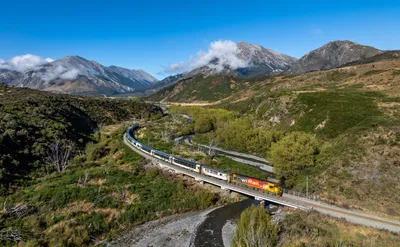
TranzAlpine
Give the first stretch a pass. It starts working when the line swings off the Main South and onto the Midland, into the Waimakariri River gorge. Sixteen tunnels and four viaducts follow, and the Staircase Viaduct is elevated as much as 75 meters. The full run is 223 kilometers in just under five hours, and it goes daily. Introduced on 22 November 1987.
 TranzAlpine - Wikipediahttps://en.wikipedia.org/wiki/TranzAlpine
 - 13
El Chepe
Copper Canyon is the reason, and the rail line gets there through 86 tunnels and 37 bridges across 673 kilometers between Chihuahua and Los Mochis. Track was not finished until 1961; it is known as the Chepe Express now. Sixteen hours one way is a long sit for it. The high point is near Divisadero at about 2,400 meters, on the continental divide, where the lookout over the canyons empties the carriages.
 Ferrocarril Chihuahua al Pacífico - Wikipediahttps://en.wikipedia.org/wiki/Ferrocarril_Chihuahua_al_Pac%C3%ADfico
 - 14
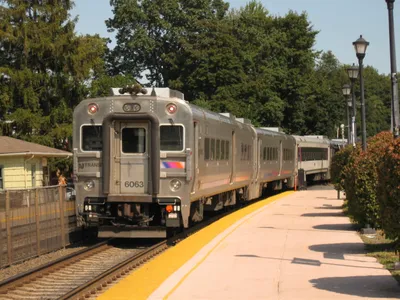
Bergen Line
Hallingskeid station was built on the Hardangervidda plateau at 1,110 meters, in an area with no population and no road access. The line crosses that plateau at 1,237 meters, the highest mainline railway in Northern Europe, and the first through train reached Oslo Østbanestasjon on 25 November 1909. Across 371 kilometers, though, the high ground is a short part of the day.
 Bergen Line - Wikipediahttps://en.wikipedia.org/wiki/Bergen_Line
 - 15
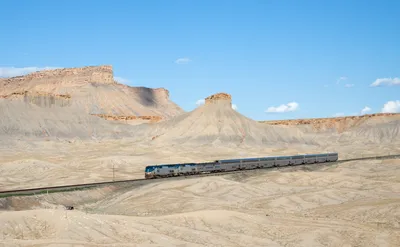
California Zephyr
Amtrak's longest daily route is this one: 2,438 miles from Chicago to Emeryville in roughly 52 and a half hours. The original service was inaugurated on 20 March 1949. Colorado is the part to stay awake for, out of the Moffat Tunnel and then along the Colorado River as far as Ruby Canyon, west of Grand Junction. Two and a bit days aboard, for one very good one.
 California Zephyr - Wikipediahttps://en.wikipedia.org/wiki/California_Zephyr
 - 16
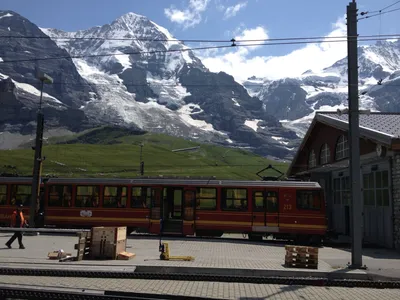
Jungfrau Railway
Rock, mostly: the nine kilometers from Kleine Scheidegg to the Jungfraujoch run essentially within the Jungfrau Tunnel, cut into the Eiger and Mönch to keep snow and weather off the line. Trains headed up pause at Eismeer station, inside the tunnel, and let passengers out for a short time. It is the highest railway in Switzerland and Europe, finishing at 3,454 meters, and since 11 December 2016 the climb takes 35 minutes rather than 52.
 Jungfrau Railway - Wikipediahttps://en.wikipedia.org/wiki/Jungfrau_Railway
 - 17

Tren a las Nubes
Rail covers 44 kilometers of this now, between San Antonio de los Cobres and the La Polvorilla viaduct, and as of November 2025 the rest of the day is a bus from Salta and back. What the train exists for is that viaduct: curved, 224 meters long, 64 meters high, sitting at 4,220 meters above sea level. The railway underneath it was inaugurated on 20 February 1948.
 Tren a las Nubes - Wikipediahttps://en.wikipedia.org/wiki/Tren_a_las_Nubes
How this list was ranked
Readers rank this list by voting items up and down. Items are ordered by reader votes.