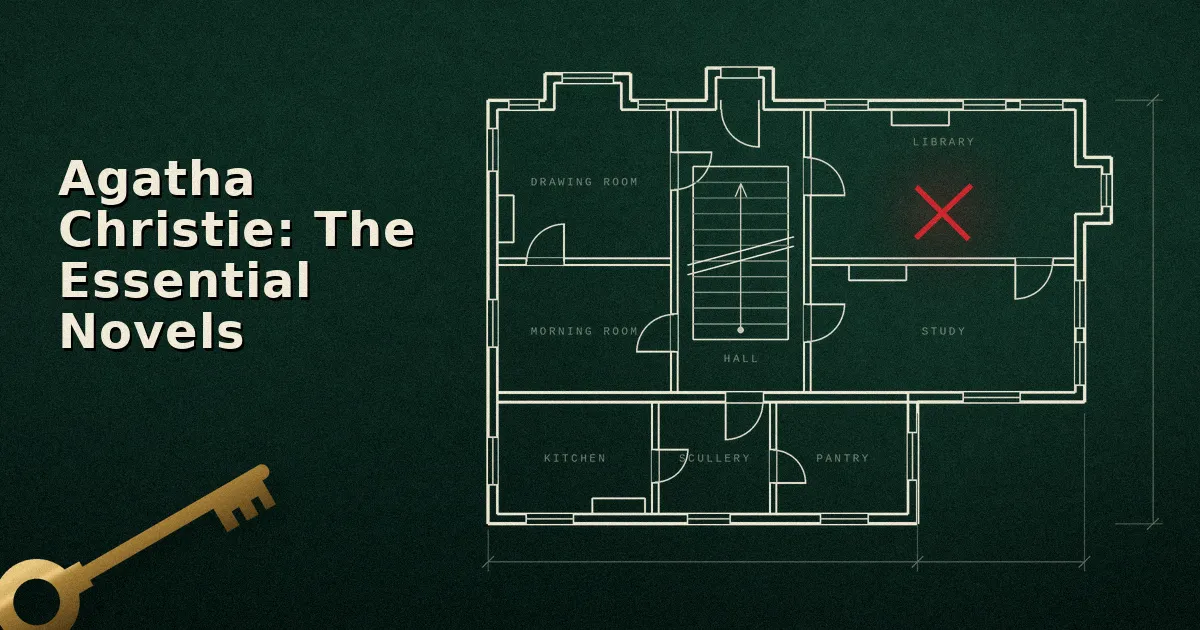
Agatha Christie: The Essential Novels
Fifteen Agatha Christie novels for a reader starting cold, ranked on construction rather than fame. Vote them into the order your own reading gives you. Novels only. The short-story collections are out, so are the plays, and so are the six Mary Westmacott books she published under a pen name. Every entry says whose case it is, because Christie is really three writers and a list that is all Poirot misrepresents her. Seven below are Poirot, four are Marple, and four have neither. The Mysterious Affair at Styles is left out on purpose: it is her first novel rather than her best, and rank fourteen goes back to its house anyway. What the ranking measures is whether the machinery still works once you know it is there. How early the clues are laid, how fairly, and whether the last chapter makes you re-read the earlier ones rather than argue with them. Nothing here is spoiled.
Agatha Christie — And Then There Were None (1939) is #1 on “Agatha Christie: The Essential Novels”.
- 1

Agatha Christie — And Then There Were None (1939)
Ten strangers are lured to Soldier Island off the Devon coast, where a gramophone record accuses each of them of a death the law never reached. Collins Crime Club published it on 6 November 1939 under a rhyme-derived title containing a racial slur; Dodd, Mead's US edition of January 1940 supplied the name used today, and a 1985 reprint was the first British publication to carry it. No detective ever appears, and the book is built so that none is needed.
 And Then There Were NoneAgatha Christie
 - 2
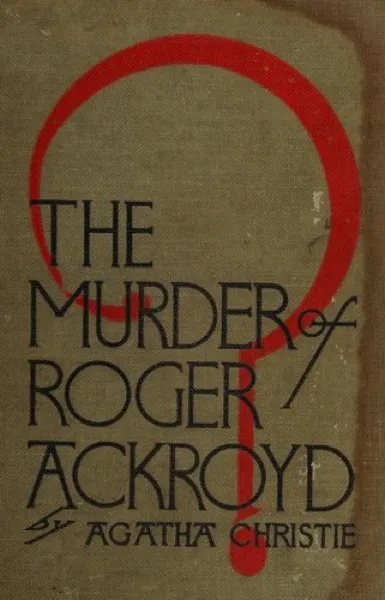
Agatha Christie — The Murder of Roger Ackroyd (1926)
Voted the best ever crime novel by the Crime Writers' Association's members, announced at Foyles in London on 5 November 2013. William Collins published it in 1926. Poirot has retired to the village of King's Abbot to grow vegetable marrows when a wealthy neighbor is killed, and the local doctor, James Sheppard, writes the account you read. Take it second rather than first: it lands hardest on a reader who already knows how a Christie normally behaves.
 The Murder of Roger AckroydAgatha Christie
 - 3
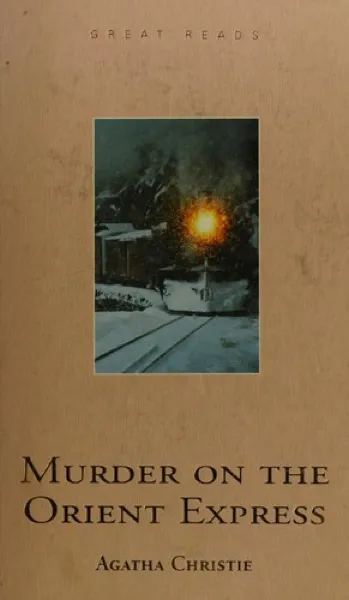
Agatha Christie — Murder on the Orient Express (1934)
Snowdrifts strand the Simplon-route train between Vinkovci and Brod, with a dead American shut inside his own compartment and every passenger in the carriage holding a reason to lie. Collins Crime Club published it on 1 January 1934; Dodd, Mead issued it in America on 28 February as Murder in the Calais Coach, dodging a clash with Graham Greene. Poirot's case, and the Daisy Armstrong backstory is the 1932 Lindbergh kidnapping barely disguised.
 Murder on the Orient ExpressAgatha Christie
 - 4
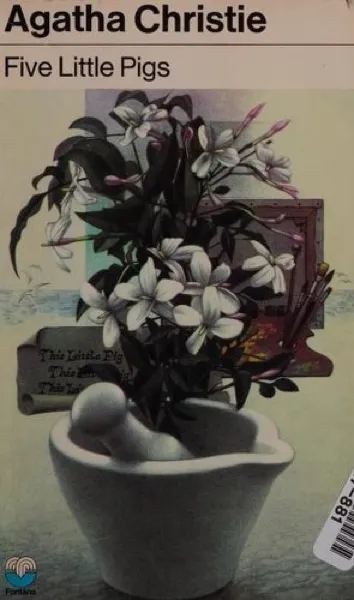
Agatha Christie — Five Little Pigs (1942)
Sixteen years after the painter Amyas Crale was poisoned in his garden studio, his daughter hires Poirot to prove her mother Caroline innocent. Witnesses write out what they remember, so one afternoon comes back five times with the furniture rearranged. Dodd, Mead published it in May 1942 as Murder in Retrospect; Collins Crime Club followed in January 1943. Robert Barnard rated it the best Christie of all, and he has a case.
 Five Little PigsAgatha Christie
 - 5
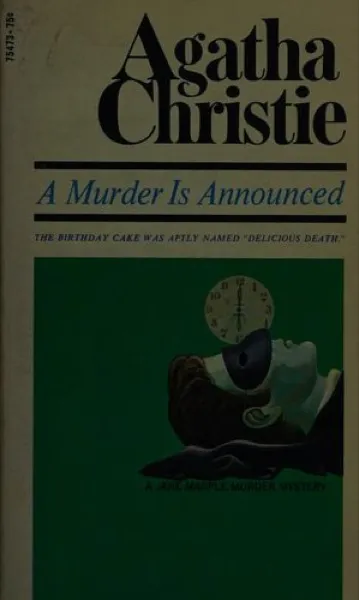
Agatha Christie — A Murder Is Announced (1950)
Chipping Cleghorn's local paper carries a notice giving the place and time of a murder that has not happened yet, and half the village turns up at Little Paddocks to watch. Collins Crime Club and Dodd, Mead both published in June 1950, promoted as Christie's fiftieth book, a count that swept in the story collections. It is Marple's strongest plot, and the ration-book England around it is genuinely observed rather than used as set dressing.
 A Murder Is AnnouncedAgatha Christie
 - 6
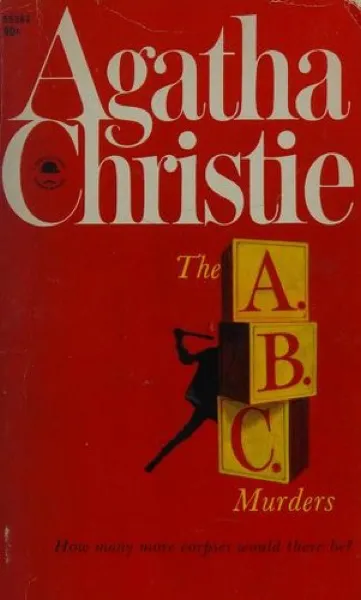
Agatha Christie — The A.B.C. Murders (1936)
Alice Ascher dies in her Andover tobacco shop, Betty Barnard on the beach at Bexhill, and an ABC railway guide lies open beside each body. Collins Crime Club published it on 6 January 1936. Isaac Anderson, in the New York Times Book Review of 16 February 1936, thought it better than Ackroyd. Poirot again. The alphabet is a smokescreen, and working out what it hides is the pleasure.
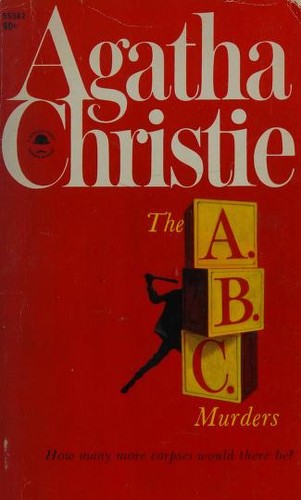 The A.B.C. MurdersAgatha Christie
 - 7
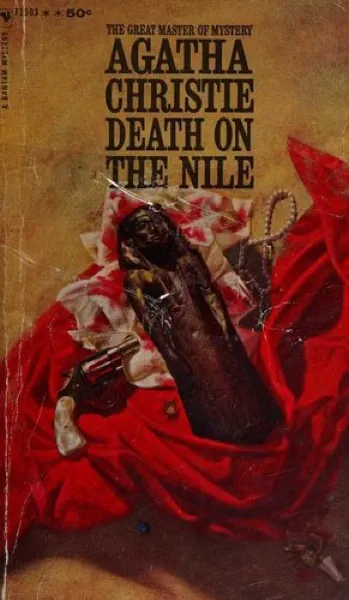
Agatha Christie — Death on the Nile (1937)
Linnet Ridgeway marries Simon Doyle, who was engaged to her friend Jacqueline de Bellefort, and Jacqueline follows the honeymoon aboard the Nile steamer Karnak. Collins Crime Club published it on 1 November 1937. E. R. Punshon wrote in the Guardian of 10 December that Christie had never handled minor characters better. For half the book Poirot is a passenger rather than an investigator, and everything needed sits in plain sight early.
 Death on the NileAgatha Christie
 - 8
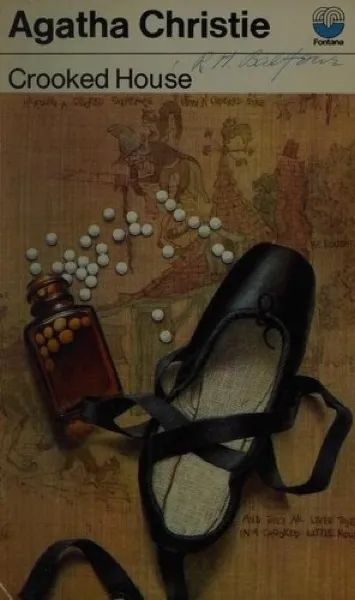
Agatha Christie — Crooked House (1949)
Aristide Leonides came from Smyrna to London in 1884 at twenty-four, made a fortune, and is poisoned decades later inside a lopsided mansion called Three Gables, three generations of his family under the one roof and every one of them plausible. Dodd, Mead published it in March 1949, Collins Crime Club on 23 May. Christie named this and Ordeal by Innocence her own favorites among her books. No series detective, and the closing pages are the coldest she wrote.
 Crooked HouseAgatha Christie
 - 9
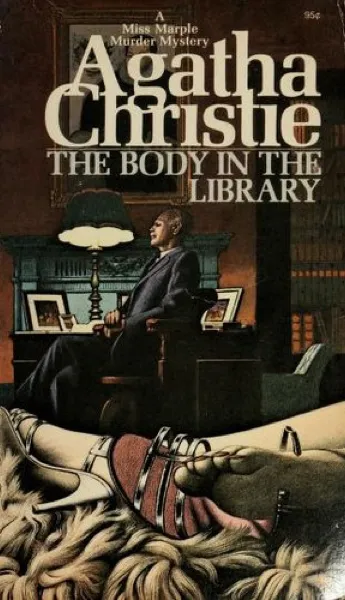
Agatha Christie — The Body in the Library (1942)
Dolly Bantry wakes her husband to report a dead blonde on the hearthrug at Gossington Hall, and the Colonel's standing in the village starts rotting from that hour. Christie set a rule in her foreword: keep the library entirely conventional, make the corpse wildly improbable. Dodd, Mead published it in February 1942, Collins Crime Club in May. Marple's case, and the best thing Christie wrote about gossip.
 The Body in the LibraryAgatha Christie
 - 10
Agatha Christie — Endless Night (1967)
Michael Rogers, a chauffeur with no prospects, wants the plot of cursed land called Gipsy's Acre, and gets it, along with a rich wife and a house by the architect Rudolf Santonix. Collins Crime Club published it on 30 October 1967 at eighteen shillings. Christie normally took three or four months over a book and wrote this in six weeks. There is no detective, and the title comes from Blake.
 Endless NightAgatha Christie
 - 11
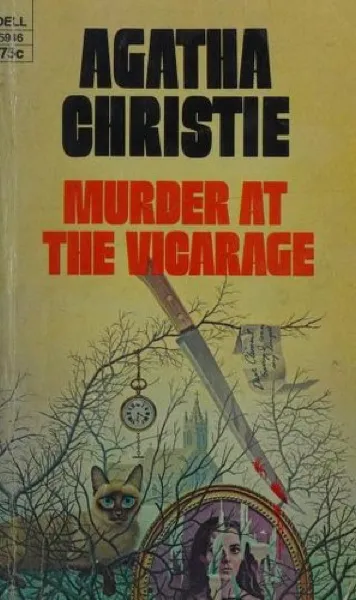
Agatha Christie — The Murder at the Vicarage (1930)
Leonard Clement, vicar of St Mary Mead, opens by remarking that killing Colonel Protheroe would be a service to the world, and is narrating an inquiry within four chapters. Collins Crime Club published it on 20 October 1930. Marple had appeared in magazine short stories from December 1927, but this is her first novel, and she arrives already sharp, unsentimental and correct.
 The Murder at the VicarageAgatha Christie
 - 12
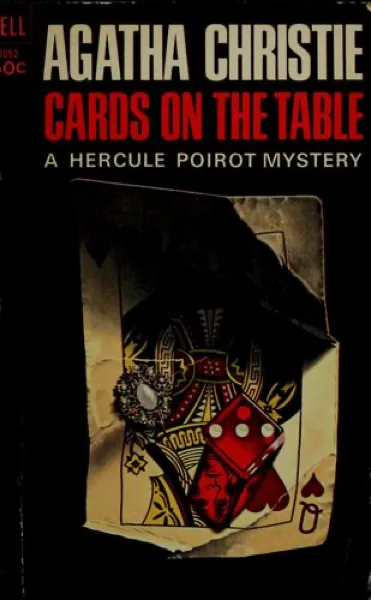
Agatha Christie — Cards on the Table (1936)
Mr Shaitana invites eight people to dinner: four detectives, and four he believes have already got away with murder. They divide into two rooms for bridge, and by the end of the rubber the host is dead in his chair. Collins Crime Club published it on 2 November 1936. Christie's foreword says the deduction must be entirely psychological, so Poirot reads the scorecards as character studies.
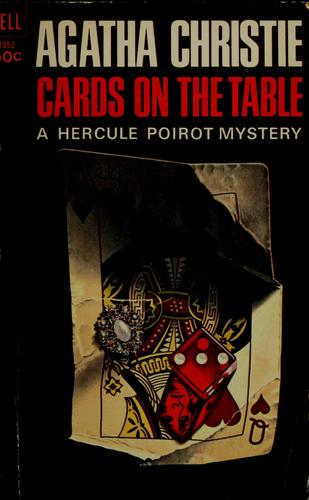 Cards on the TableAgatha Christie
 - 13
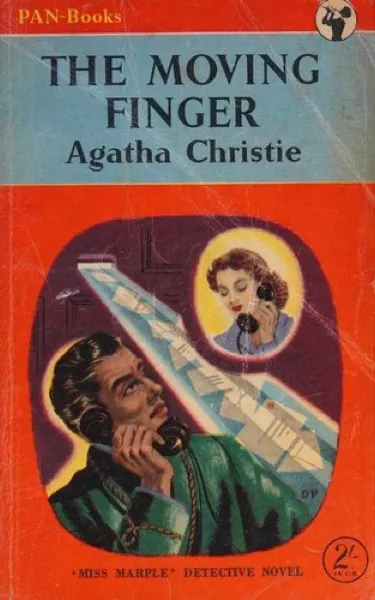
Agatha Christie — The Moving Finger (1942)
Jerry Burton, grounded after a flying crash, moves with his sister to Lymstock to convalesce and finds the village drowning in poison-pen letters accusing everyone of something. Dodd, Mead published it in July 1942, Collins Crime Club not until June 1943. Christie wrote in her autobiography that she was really pleased with it. Marple turns up only in the last quarter, after the police have run out of ideas.
 The Moving FingerAgatha Christie
 - 14
Agatha Christie — Curtain: Poirot's Last Case (1975)
Written during the Blitz of 1940-41 in case she was killed in the raids, then kept in a bank vault and issued by Collins Crime Club in September 1975, thirty-four years on. Poirot comes back to Styles Court in Essex, the house of his first English case, in a wheelchair and dyeing his hair. The New York Times gave him a front-page obituary on 6 August 1975. Read it fifteenth rather than first.
 CurtainAgatha Christie
 - 15
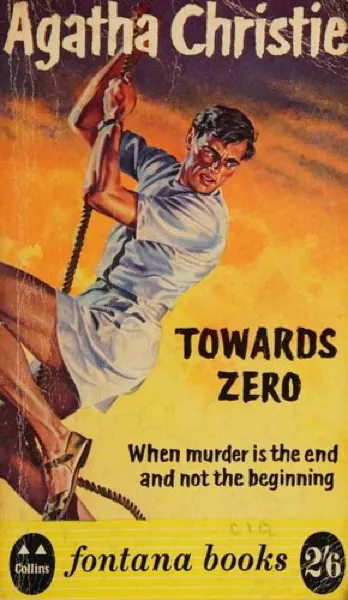
Agatha Christie — Towards Zero (1944)
Nobody dies for a third of the book. Starting months early with a suicide attempt, a shoplifting accusation and a tennis player's two wives, the novel walks its cast forward to the hour when the murder finally happens. Dodd, Mead published it in June 1944, Collins Crime Club in July. Superintendent Battle investigates at Gull's Point, Saltcreek, so neither Poirot nor Marple. It is her boldest structure.
 Towards ZeroAgatha Christie
How this list was ranked
Readers rank this list by voting items up and down. Items are ordered by reader votes.