US Airports, Ranked from Best to Worst
Sixteen big US airports, ranked and open to your vote, scored rather than surveyed: each one takes marks on three tests and the total sets the order. Test one is arrival, meaning whether a train reaches the terminal building or you are handed a shuttle. Test two, worth the most, is how much of the airport you can still reach after clearing security once. Test three, worth the least, is what the place gives you while you wait, and that mark is a preference rather than a measurement. Punctuality is deliberately not part of it, because that would be a different list. Tied totals break on the higher test-two mark, then the higher test-one mark, then on which is the better place to be stuck. One airport per metro area keeps New York and Chicago from taking four slots between them. Every score comes from what each airport's own article states.
San Francisco International Airport is #1 on “US Airports, Ranked from Best to Worst”.
- 1
San Francisco International Airport
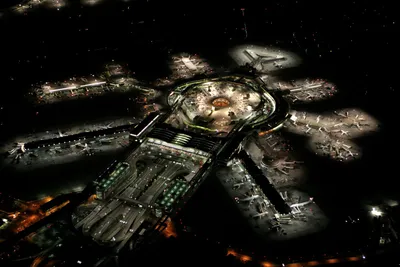
Since June 17, 2024 you can walk from the International Terminal through Terminals 1, 2 and 3 and back again without clearing security twice: a complete airside ring, and the reason this sits first. BART trains board at the terminals themselves. SFO Museum, created in 1980 as the first museum inside an international airport, fills the cases along the way. The parallel runway centerlines sit 750 feet apart, so overcast weather halves the usable runways.
 San Francisco International Airport - Wikipediahttps://en.wikipedia.org/wiki/San_Francisco_International_Airport
 - 2
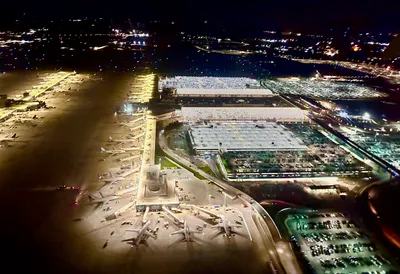
Hartsfield–Jackson Atlanta International Airport
Busiest airport on earth by passenger count, at 108.1 million in 2024, and it still moves people better than fields a fifth its size. MARTA's Red and Gold lines stop at the domestic terminal. Past security the Plane Train runs 24/7 under the Transportation Mall and reaches every concourse from T to F, so a gate change costs minutes rather than a second pass through screening.
 Hartsfield–Jackson Atlanta International Airport - Wikipediahttps://en.wikipedia.org/wiki/Hartsfield%E2%80%93Jackson_Atlanta_International_Airport
 - 3
Dallas Fort Worth International Airport
Second-largest US airport by land area after Denver, at 17,207 acres, and organized far better than that number suggests. Skylink is the reason: the people mover links the terminals inside security, averaging about seven minutes end to end, so crossing the field never costs a second screening. DART's Orange Line reaches the Terminal A station and TEXRail runs in from downtown Fort Worth.
 Dallas Fort Worth International Airport - Wikipediahttps://en.wikipedia.org/wiki/Dallas_Fort_Worth_International_Airport
 - 4
Denver International Airport
Opened on February 28, 1995, with more room around it than any other commercial airport in North America. RTD's A Line covers the 37 minutes to Union Station about every 15 minutes, and the underground train serves all three concourses, so nothing here depends on a bus. Out on the approach road stands Blue Mustang, Luis Jiménez's 32-foot fiberglass horse with glowing red eyes, commissioned back in 1993.
 Denver International Airport - Wikipediahttps://en.wikipedia.org/wiki/Denver_International_Airport
 - 5
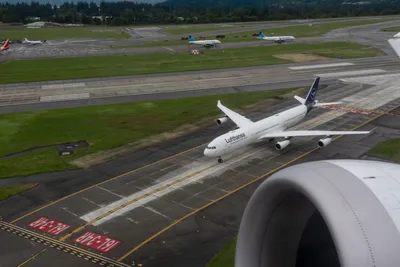
Seattle–Tacoma International Airport
Three lines of automated people mover, called the SEA Underground, tie the North and South Satellites to the four concourses in the main terminal, so the whole field works as one building. The airport station opened on December 19, 2009, bridged across level 4 of the garage. Then there is the art: 289 works of painting, mural, stained glass and sculpture, hung along the concourses where passengers actually walk.
 Seattle–Tacoma International Airport - Wikipediahttps://en.wikipedia.org/wiki/Seattle%E2%80%93Tacoma_International_Airport
 - 6
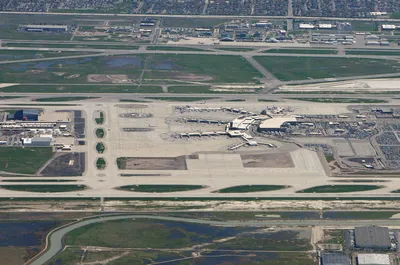
Salt Lake City International Airport
Rebuilt almost from scratch, with phase 1 of the new terminal opening in 2020, and TRAX light rail runs in from the Airport station. A single terminal holds two concourses joined by two underground tunnels, so 83 gates sit behind one screening. The complaint is distance, and the central tunnel reaches Concourse B straight from beyond the checkpoint and cuts that walk by as much as half.
 Salt Lake City International Airport - Wikipediahttps://en.wikipedia.org/wiki/Salt_Lake_City_International_Airport
 - 7
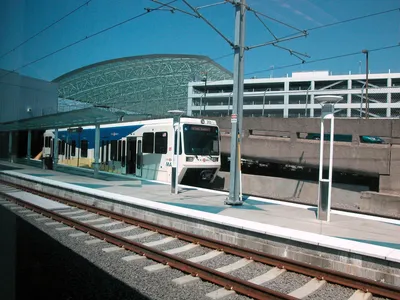
Portland International Airport
Light rail reached the terminal door here on September 10, 2001, when the Airport MAX extension opened, and the Red Line still ends beside the ticket lobby. What costs it places is inside: the secure-side concourse connector, opened in August 2005, closed permanently on January 5, 2021 for the expansion. Phase one of the new main terminal opened on August 14, 2024, and the 1987 carpet, drawn to stylize the criss-crossing runways, still outshines it.
 Portland International Airport - Wikipediahttps://en.wikipedia.org/wiki/Portland_International_Airport
 - 8
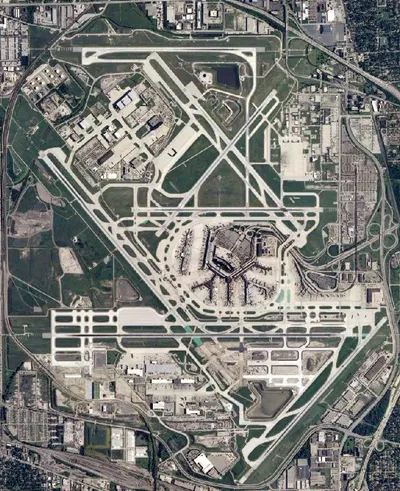
O'Hare International Airport
Named in 1949 for Edward "Butch" O'Hare, the US Navy's first flying ace of the Second World War, and served by the Blue Line's north terminus straight from downtown. The catch is Terminal 5: reaching it from Terminals 1 to 3 means leaving security and clearing it again, unless you catch the airside shuttle that runs 11:30 am to 9:30 pm. Michael Hayden's neon tunnel Sky's the Limit has glowed since 1987.
 O'Hare International Airport - Wikipediahttps://en.wikipedia.org/wiki/O%27Hare_International_Airport
 - 9
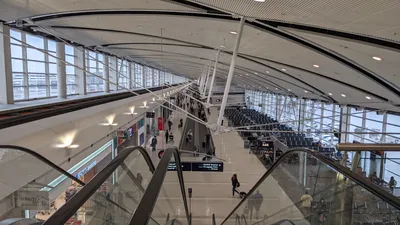
Detroit Metropolitan Wayne County Airport
McNamara Terminal opened on February 24, 2002, the first major US airport terminal to open after the September 11 attacks, and it beats most of what has been built since. Concourses B and C reach Concourse A through the underground Light Tunnel, where sculpted glass panels carry a color show set to a score by Victor Alexeeff. Arrival is the weak part: no rail, just SMART bus route 261 since January 2018.
 Detroit Metropolitan Airport - Wikipediahttps://en.wikipedia.org/wiki/Detroit_Metropolitan_Wayne_County_Airport
 - 10
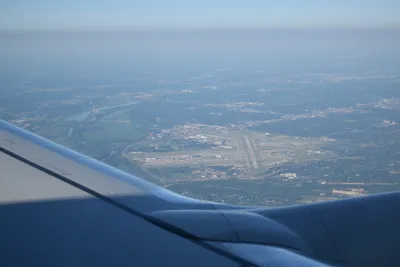
Minneapolis–Saint Paul International Airport
Started in 1919 as Speedway Field, on the wreckage of the bankrupt Twin City Speedway race track, which explains the odd geometry. The two terminals sit about a mile apart and are not connected within the airport facilities, so switching between them means the Blue Line, which at least charges nothing for that hop. Terminal 1 carries Charles Lindbergh's name, Terminal 2 Hubert Humphrey's.
 Minneapolis–Saint Paul International Airport - Wikipediahttps://en.wikipedia.org/wiki/Minneapolis%E2%80%93Saint_Paul_International_Airport
 - 11
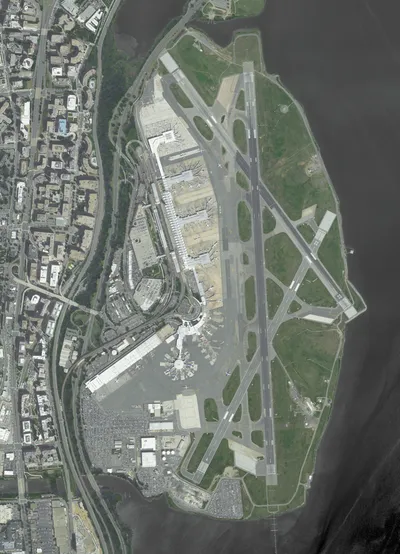
Ronald Reagan Washington National Airport
Federal law keeps this one short-haul: a perimeter rule implemented in 1966 originally capped nonstop service at 650 statute miles, pushing long flights out to Dulles. The Metro makes up for it, with Yellow and Blue line trains on an elevated outdoor platform beside Terminal 2 and indoor pedestrian bridges into Cesar Pelli's 35-gate concourses. The two terminals are not connected to each other post-security, so Terminal 1's nine gates are their own island.
 Ronald Reagan Washington National Airport - Wikipediahttps://en.wikipedia.org/wiki/Ronald_Reagan_Washington_National_Airport
 - 12
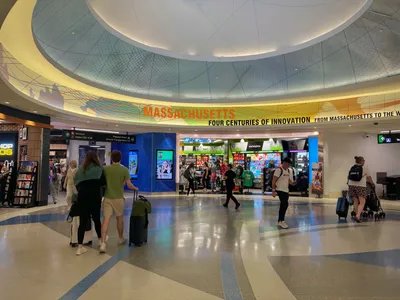
Boston Logan International Airport
Hemmed in by Boston Harbor since it opened on September 8, 1923, which is why 2,384 acres has to hold six runways. Transit here is a bus that behaves like a train: the Silver Line's SL1 branch calls at every terminal and runs through to South Station downtown. Post-security connection covers Terminals B, C and E, which leaves Terminal A outside the arrangement.
 Logan International Airport - Wikipediahttps://en.wikipedia.org/wiki/Logan_International_Airport
 - 13
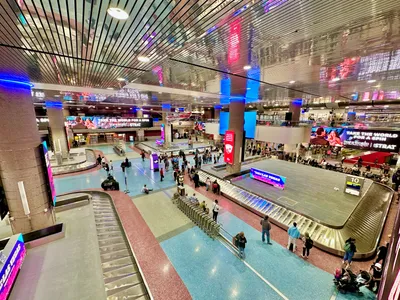
Harry Reid International Airport
Renamed in December 2021 by the Clark County Commission, which is why so much signage and so much muscle memory still says McCarran. Nevada gaming law lets it keep slot machines in the passenger terminals, something almost no other US airport can do. Green and blue tram lines run from Terminal 1 to Concourses C and D, a red line from Terminal 3 to D, but public transit in is an RTC bus off Level 0.
 Harry Reid International Airport - Wikipediahttps://en.wikipedia.org/wiki/Harry_Reid_International_Airport
 - 14
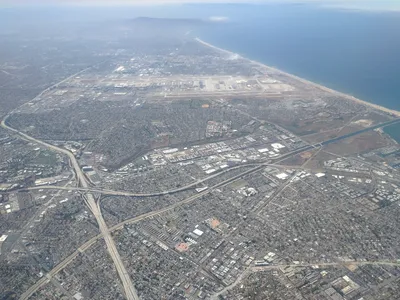
Los Angeles International Airport
Nine terminals in a horseshoe, and inside the secure area tunnels or above-ground connectors link all of them except the regional terminal, which is better than the reputation suggests. Getting there is the problem, and in August 2026 it still was: no direct connection to the Los Angeles Metro Rail system, a free shuttle covering the mile and a half to the transit center, and SkyLink still under construction. The 1961 Theme Building watches from the middle.
 Los Angeles International Airport - Wikipediahttps://en.wikipedia.org/wiki/Los_Angeles_International_Airport
 - 15
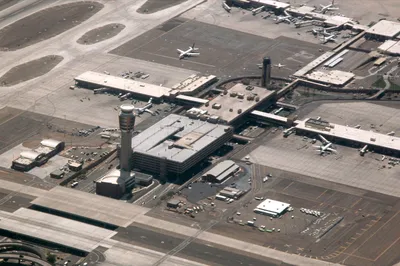
Phoenix Sky Harbor International Airport
The name came from J. Parker Van Zandt, who bought 278 acres of farmland in November 1928 for his Scenic Airways operation. Valley Metro Rail stops at the 44th Street and Washington station, described as nearby rather than here, and the PHX Sky Train covers the remaining distance. Phase 1 opened on April 8, 2013 and also serves East Economy Parking. Two terminals, numbered 3 and 4, hold 119 gates between them.
 Phoenix Sky Harbor International Airport - Wikipediahttps://en.wikipedia.org/wiki/Phoenix_Sky_Harbor_International_Airport
 - 16
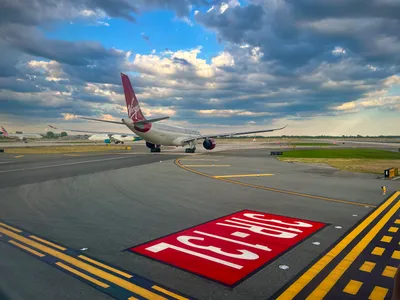
John F. Kennedy International Airport
Five active terminals, 130 gates, and this line from the airport's own article: many inter-terminal connections require passengers to exit security, use the AirTrain, then re-clear security. That is last place, earned. AirTrain opened on December 17, 2003, free on airport property, with paid transfers onto the subway and the Long Island Rail Road. The redemption is Eero Saarinen's 1962 TWA Flight Center, reopened in 2019 as the TWA Hotel.
https://en.wikipedia.org/wiki/John_F._Kennedy_International_Airport
How this list was ranked
Readers rank this list by voting items up and down. Items are ordered by reader votes.