The Optical Illusions Worth Understanding, in Order
The order is editorial. It runs in four units grouped by the mechanism each illusion demonstrates: size, lightness, shape, then the ones that only happen over time. Inside a unit the sequence is a teaching order, chosen here rather than dictated by the articles. Where a linked article names another entry on this list, the entry says so, and those steps you can check by clicking — Ebbinghaus naming Ponzo, Delboeuf citing Ebbinghaus, Cornsweet defined against Mach bands, and the lilac chaser, whose article says the effect is built out of entries sitting directly above it. Everywhere else the grouping is thematic, and pretending otherwise would be a lie you could catch by clicking. Each entry also reports what its own article does about the cause: commits, names rivals, or names none. Fame is not a way in; the 2015 dress photograph is absent because its article opens as a viral phenomenon. Disagree with the running order? Fork it and build the one you would teach from.
Ponzo illusion is #1 on “The Optical Illusions Worth Understanding, in Order”, ranked by ListWorld Other Desk.
- 1
Ponzo illusion
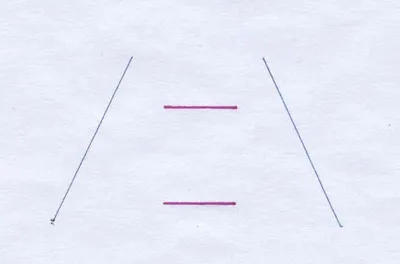
Identical horizontal bars sit across a pair of oblique lines that converge toward a vanishing point — and the upper bar wins. Cover the oblique lines with a thumb and the bars go back to matching. Mario Ponzo, whose name it carries, suggested in 1912 that the same effect explains the Moon illusion. The size unit opens on an argument: the article sets a perspective hypothesis against a framing-effects hypothesis about the gap between bar and line.
 Ponzo illusion - Wikipediahttps://en.wikipedia.org/wiki/Ponzo_illusion
 - 2
Ames room
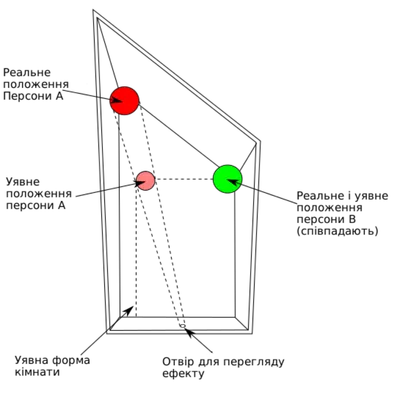
Adelbert Ames Jr. patented this distorted room in 1940 — an entry in the size unit that you walk into rather than look at. Look through the peephole with one eye: an adult in one back corner appears to be a giant, an adult in the other a dwarf. The article commits to one cause. The geometry, built using perspective, throws the same image onto the retina as an ordinary room would, and the peephole blocks stereopsis and motion parallax.
 Ames room - Wikipediahttps://en.wikipedia.org/wiki/Ames_room
 - 3

Ebbinghaus illusion
Depth cues gone, size still moves, so the size unit continues. Compare the two centre discs and ignore the rings around them: one is circled by large discs, one by small, and the centres match. Hermann Ebbinghaus discovered it; Edward B. Titchener popularised it in a 1901 textbook. The article names no cause — it offers a correlate instead, that receptivity to this and to the Ponzo illusion runs inversely with the size of the viewer's primary visual cortex.
 Ebbinghaus illusion - Wikipediahttps://en.wikipedia.org/wiki/Ebbinghaus_illusion
 - 4
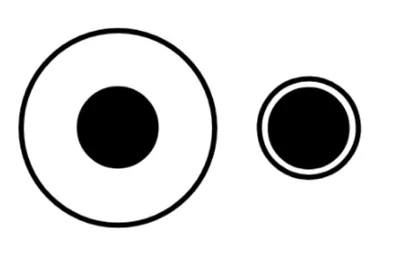
Delboeuf illusion
Draw a ring close around a disc and the disc looks bigger; draw the ring wide and it looks smaller. Joseph Remi Leopold Delboeuf found that in 1865. His article names no single cause: assimilation and contrast sit beside a 2005 study suggesting the same visual processes cause this and the Ebbinghaus — a clickable link inside the size unit. Ittersum and Wansink found in 2012 that people pour 9.9% more soup into a larger bowl.
 Delboeuf illusion - Wikipediahttps://en.wikipedia.org/wiki/Delboeuf_illusion
 - 5
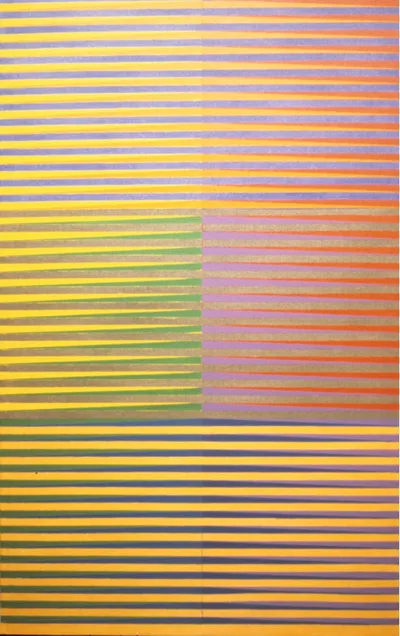
Mach bands
The lightness unit starts with the entry whose article states a cause outright: the effect is due to spatial high-boost filtering on the luminance channel. Where two flat greys meet along a ramp, a bright stripe and a dark stripe appear at the join that are nowhere in the image. Look at the join, not at the greys themselves. Ernst Mach reported it in 1865, conjecturing that the filtering happens in the retina, by lateral inhibition among its neurons.
 Mach bands - Wikipediahttps://en.wikipedia.org/wiki/Mach_bands
 - 6

Cornsweet illusion
The article's own instruction is to black out the region containing the edge with a strip of paper; doing that collapses the effect and the two halves turn out to be the same grey. Tom Cornsweet described it in the late 1960s, after earlier observations by Kenneth Craik and Vivian O'Brien. No single cause is named. What the article states instead is the lightness unit's internal contrast — in Mach bands the effect stays close to the intensity gradient.
 Cornsweet illusion - Wikipediahttps://en.wikipedia.org/wiki/Cornsweet_illusion
 - 7
Illusory contours
Discs with wedge-shaped portions removed, lined up so the gaps agree, and a bright triangle turns up carrying a border you can trace even though no luminance change crosses it. That invented edge opens the shape unit. Gaetano Kanizsa popularised the configuration; Friedrich Schumann is usually credited with the discovery around the beginning of the 20th century. The article commits — early visual cortical regions such as V1 and V2 are thought to do the forming.
 Illusory contour - Wikipediahttps://en.wikipedia.org/wiki/Illusory_contour
 - 8
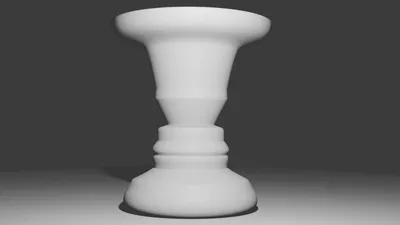
Rubin vase
Once the shape unit has handed you an invented edge, the question becomes which side of an edge owns it. Edgar Rubin set out the figure and ground relationship in his 1915 doctoral thesis. Watch the bounding contour switch sides as the vase becomes two profiles facing each other: it belongs to whichever region you take as the figure, and the other flattens into a formless background. Both readings fit the same retinal image, and one holds at a time.
 Rubin vase - Wikipediahttps://en.wikipedia.org/wiki/Rubin_vase
 - 9
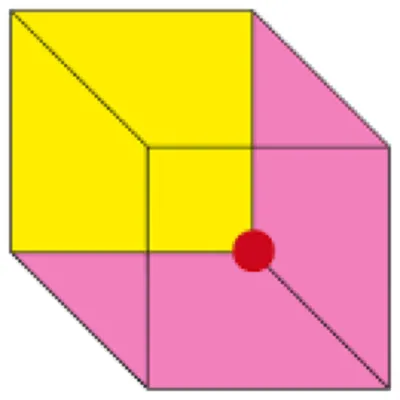
Necker cube
Ambiguity gets its hardest test at the end of the shape unit. Louis Albert Necker published the figure as a rhomboid in 1832. Stare at the front face until it becomes the back face — each part of the drawing is ambiguous by itself, yet the visual system picks readings of the parts that make the whole consistent. Why one reading arrives first is hedged: possibly because people see objects from above far more often than from below.
 Necker cube - Wikipediahttps://en.wikipedia.org/wiki/Necker_cube
 - 10
Motion aftereffect
A waterfall for about a minute, then the rocks beside it — and the rocks drift upward. Robert Addams reported exactly that at the Falls of Foyers in Scotland in 1834. The time unit opens on adaptation. This article names a cause and hedges it in the same breath: the effect is believed to be the result of motion adaptation, and the balance among direction-coding neurons is offered as one theory rather than a finding.
 Motion aftereffect - Wikipediahttps://en.wikipedia.org/wiki/Motion_aftereffect
 - 11
Afterimage
Colour adapts too, one step further into the time unit. Stare at the middle stripe of an inverted US flag for 25 to 30 seconds, then blink at a wall, and the flag comes back in its real colours. Opponent processing covers the negative kind, so a green image produces a magenta afterimage. Positive ones are the honest gap here — their cause is not well known, though persisting brain activity gets offered.
 Afterimage - Wikipediahttps://en.wikipedia.org/wiki/Afterimage
 - 12
Troxler's fading
Adaptation can delete a whole shape and not just its colour. Fix your eyes on one point and hold them there; an unchanging stimulus away from that point fades out and disappears. Ignaz Paul Vital Troxler identified the effect in 1804, while practising in Vienna. The time unit's third entry commits to neural adaptation and then updates itself — Hsieh and Tse showed that at least some of the fading happens in the brain rather than the eyes.
 Troxler's fading - Wikipediahttps://en.wikipedia.org/wiki/Troxler's_fading
 - 13
Phi phenomenon
Motion can also be invented where nothing moved. Watch the space between the two flashes rather than the flashes themselves — two nearby stimuli alternating at high frequency give a diffuse, amorphous shadowlike something that jumps in front of them. Max Wertheimer introduced the symbol for it in 1912. Beta movement, seen at lower frequencies, is the one credited with motion in cinema. The time unit's fourth entry names a Hassenstein–Reichardt detector model and picks no cause.
Phi phenomenon - Wikipediahttps://en.wikipedia.org/wiki/Phi_phenomenon - 14
Lilac chaser
Hold your eyes on the centre cross for at least 30 seconds and count three separate illusions: a gap running around the ring of lilac discs, a green disc running in place of that gap, then the lilac discs gone and the green one on bare grey. Jeremy Hinton created it before 2005. It closes the time unit because its article calls the effect the phi phenomenon plus an afterimage plus Troxler's fading — the three entries directly above it.
Lilac chaser - Wikipediahttps://en.wikipedia.org/wiki/Lilac_chaser
How this list was ranked
This list is ranked by ListWorld Other Desk, not by community vote.