The Best Word Games, from the Crossword to Wordle
Ranked oldest first, by the earliest date each game's own Wikipedia article gives for its first public appearance. Vote it into a quality order if you disagree. One rule got things in: the article's opening genus has to contain the words “word game”. That admits the crossword, which opens “A crossword (or crossword puzzle) is a word game”, though two older games here beat it into print, and it keeps Taboo, “a word, guessing, and party game”. It drops Connections, “a daily category-matching puzzle” by its own account; the cryptic crossword, which claims only to be a crossword puzzle; and Hangman, “a guessing game” with no “word” anywhere in the phrase. The lineage claim is narrower than the slogan: Wordle asks Jotto's 1955 question, a secret five-letter word hunted by guessing real words, and answers it in colour instead of a number. Quordle and Strands sit it out as variations on games already here. The order does run paper to phone, but the dates sorted it, not the medium.
Anagrams is #1 on “The Best Word Games, from the Crossword to Wordle”.
- 1
Anagrams
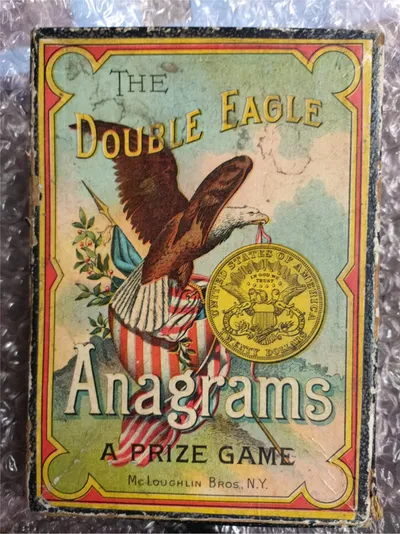
Published under a pile of other names, Snatch and Word Making and Taking among them, this is the oldest game here: Wikipedia dates an early modern version to Charles Hammett's Word Making and Taking, released in 1877. Tiles lie face-up in the middle and the fun is stealing — take a word someone already built, add a letter, rearrange the lot into a new one.
 Anagrams (game) - Wikipediahttps://en.wikipedia.org/wiki/Anagrams_(game)
 - 2
Word ladder
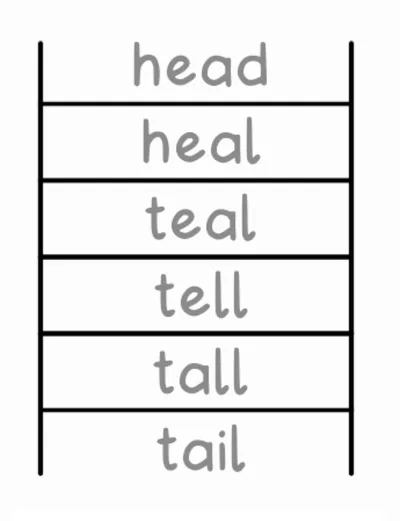
Lewis Carroll invented this one. He published a run of the puzzles under the name Doublets in the magazine Vanity Fair, beginning with the 29 March 1879 issue. Change one letter at a time, and every rung has to be a real word of the same length, which is what makes a four-letter climb harder than it looks.
 Word ladder - Wikipediahttps://en.wikipedia.org/wiki/Word_ladder
 - 3
Crossword
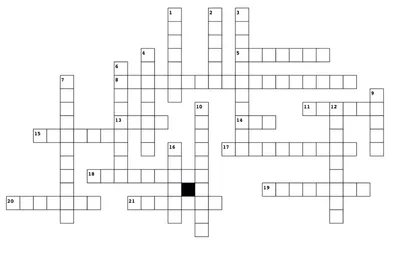
On 21 December 1913 Arthur Wynne, a journalist born in Liverpool, published a “word-cross” puzzle in the New York World that, the article says, embodied most of the features of the modern genre. Its lead answers the question this list's title raises — “A crossword (or crossword puzzle) is a word game consisting of a grid of black and white squares”.
 Crossword - Wikipediahttps://en.wikipedia.org/wiki/Crossword
 - 4
Scrabble
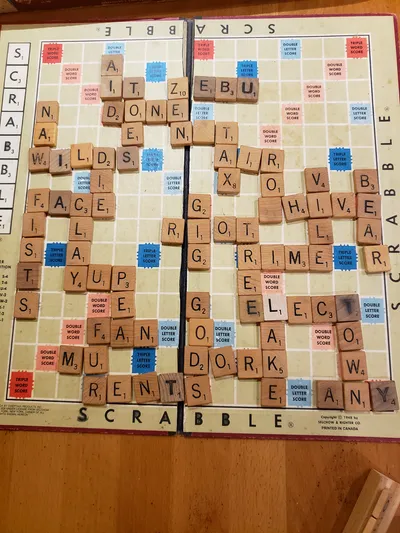
An architect built it. Alfred Mosher Butts created the game in 1931 as a variation on an earlier word game of his called Lexiko, and it took another eighteen years to reach buyers — in 1949 James Brunot and his family made sets in a converted former schoolhouse in Dodgingtown, Connecticut. It was sold in 121 countries and available in more than 30 languages as of 2008, a date that has to travel with the number.
 Scrabble - Wikipediahttps://en.wikipedia.org/wiki/Scrabble
 - 5

Jotto
Pen, paper, and a secret five-letter word each, written down privately. Morton M. Rosenfeld invented it in 1955 and marketed it through his New York-based Jotto Corp. You guess a five-letter word and the reply is a bare count of how many letters match — no positions and no colours. The article's see-also list points at Wordle as a similar 2021 web game, which is one way to put it.
 Jotto - Wikipediahttps://en.wikipedia.org/wiki/Jotto
 - 6
Word search
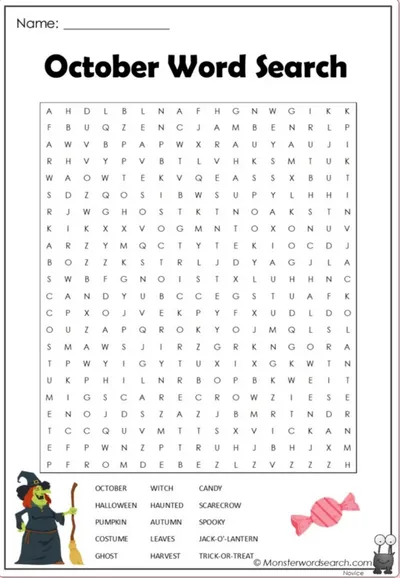
Grids with words buried in them got their documented debut on March 1, 1968, when Norman E. Gibat published one in the Selenby Digest in Norman, Oklahoma. The article then qualifies its own claim: the Spanish puzzle creator Pedro Ocón de Oro was publishing “Sopas de letras” before that date, with no date given. So 1968 is the earliest year the article will commit to.
 Word search - Wikipediahttps://en.wikipedia.org/wiki/Word_search
 - 7
Boggle
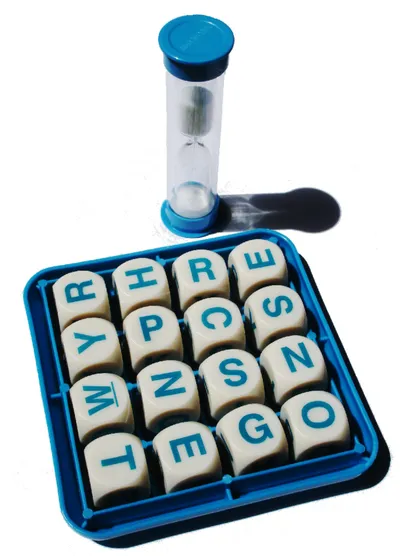
Sixteen cubic dice go into a covered tray, someone shakes it, and a three-minute sand timer starts. Allan Turoff invented the design; Parker Brothers revisited it in 1972 while developing a line of word games, then refined and renamed it and released it for the 1973 holiday shopping season. Everyone hunts the same grid at the same time — the one thing Scrabble cannot do.
 Boggle - Wikipediahttps://en.wikipedia.org/wiki/Boggle
 - 8
Taboo
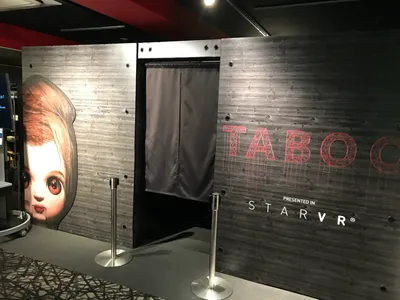
Get your team to say the guess word at the top of the card without using any of the five taboo words printed below it. Parker Brothers published it in 1989, and the article notes the company was subsequently purchased by Hasbro. Speech only — gestures, sounds and drawings are all barred, and the other team parks a censor beside you with a finger on the buzzer.
 Taboo (game) - Wikipediahttps://en.wikipedia.org/wiki/Taboo_(game)
 - 9
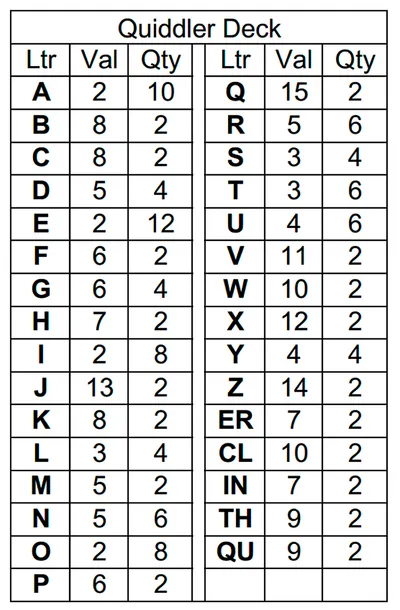
Quiddler
Tiles give way to cards. Marsha J. Falco designed it and Set Enterprises published it in 1998, and the deck runs to 118 cards, each carrying a single letter or a common two-letter combination. A game is eight rounds: a three-card hand for the first, growing to a ten-card hand for the last — the hands get bigger every round and the words have to keep up.
 Quiddler - Wikipediahttps://en.wikipedia.org/wiki/Quiddler
 - 10
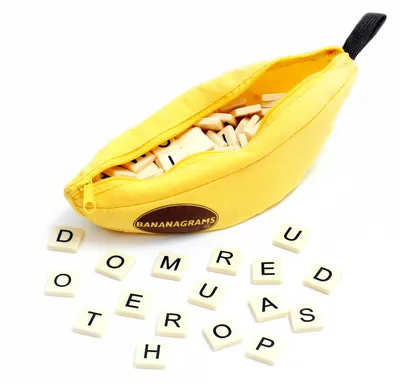
Bananagrams
There is no board and nothing to score. Abraham and Rena Nathanson of Cranston, Rhode Island made it, and it reached the public in January 2006 at the London Toy Fair. The 144 tiles come in a fabric banana-shaped package, and each player races to build their own word grid — empty your letters and you call “Peel!”, which makes everyone draw a new tile.
 Bananagrams - Wikipediahttps://en.wikipedia.org/wiki/Bananagrams
 - 11

Words with Friends
Cross-platform play was the point. Newtoy released it in July 2009 for Android, Windows Phone and iOS, and up to 40 games can run at once, push notifications telling you whose turn it is. The rules track two-player Scrabble with small edits — a seven-tile play pays 35 bonus points rather than Scrabble's 50. As of May 2017 it was the most popular mobile game in the United States.
 Words with Friends - Wikipediahttps://en.wikipedia.org/wiki/Words_with_Friends
 - 12
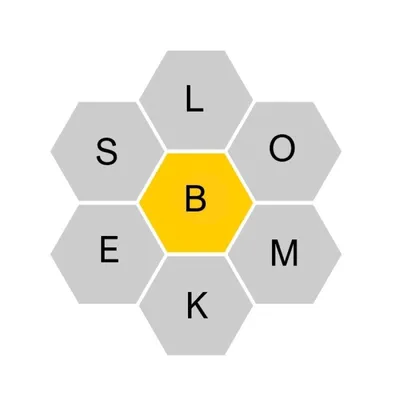
Spelling Bee
A weekly print puzzle first: Frank Longo created it for The New York Times and it debuted on February 22, 2015, years before the paper bought Wordle. Seven letters sit in a honeycomb, words have to run four letters or longer, and every single one must use the letter in the centre. Each puzzle is guaranteed at least one pangram — a word using all seven.
 The New York Times Spelling Bee - Wikipediahttps://en.wikipedia.org/wiki/The_New_York_Times_Spelling_Bee
 - 13
Wordle
Josh Wardle, a Welsh software engineer, built it for his partner and released it publicly in October 2021. Green marks the right letter in the right spot, yellow the right letter in the wrong spot, grey means it is not in the word. That is Jotto's count of matching letters, split out by position and coloured in — the whole invention. Friends in New Zealand came up with the emoji grid people post.
Wordle - Wikipediahttps://en.wikipedia.org/wiki/Wordle
How this list was ranked
Readers rank this list by voting items up and down. Items are ordered by reader votes.