Dinosaurs, Ranked — Settled by Vote
Rank a dinosaur by the gap between the animal you picture and the animal in the ground. Vote it into better shape. The measure is how wide that gap is and which way it runs, not how faithful any particular film was. Near the top sit the animals the fossil record keeps improving on: a pair of arms that waited decades for a body, a predator built back up after its type material was destroyed in the war. Lower down are the ones whose reputation runs ahead of the bones — a turkey-sized hunter the films made man-sized, a crested theropod handed venom it never had. Eligibility is the clade, not the word: Dinosauria only, which keeps out pterosaurs, the marine reptiles, and Dimetrodon's synapsid line however often they turn up in the toy box. Every entry carries the body length its own linked article gives, so you can see how little the order tracks size. Brontosaurus is here and Apatosaurus isn't, because their leads give the same range and each says they may be the same animal.
Deinocheirus is #1 on “Dinosaurs, Ranked — Settled by Vote”.
- 1
Deinocheirus
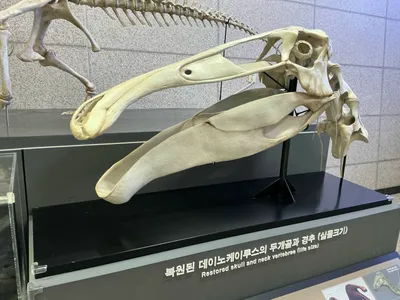
A pair of arms 2.4 m (7.9 ft) long came out of Mongolia's Nemegt Formation in 1965, and for decades that was the entire animal. Two more complete specimens described in 2014 filled in an 11 m (36 ft) ornithomimosaur with a wide bill and a deep lower jaw closer to a hadrosaur's than to a predator's — a body no film had guessed at. Its article's first sentence never uses the word dinosaur.
 Deinocheirus - Wikipediahttps://en.wikipedia.org/wiki/Deinocheirus
 - 2
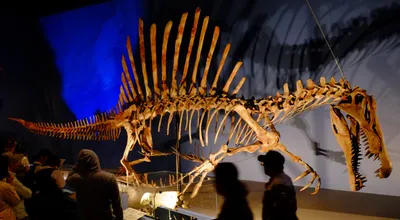
Spinosaurus
Egyptian remains found in 1912 and described by Ernst Stromer in 1915 were destroyed in World War II, and the genus had to be built back up from material that came to light in the early 21st century. A 2022 study suggests S. aegyptiacus reached 14 m (46 ft) and 7.4 t (8.2 short tons), with neural spines at least 1.65 m long — how well it swam is strongly contested.
 Spinosaurus - Wikipediahttps://en.wikipedia.org/wiki/Spinosaurus
 - 3
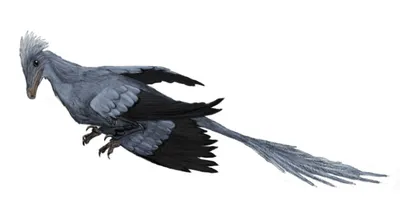
Microraptor
Long pennaceous feathers formed aerodynamic surfaces on the arms and tail and also on the legs, which is why Xu Xing in 2003 described the first specimen preserving that feature as a four-winged dinosaur. The holotype of M. gui measured 77 centimetres (2.53 ft) with a wingspan of 88–94 centimetres. A later specimen, BMNHC PH881, carried probably glossy-black iridescent plumage — colour, off a fossil slab.
 Microraptor - Wikipediahttps://en.wikipedia.org/wiki/Microraptor
 - 4
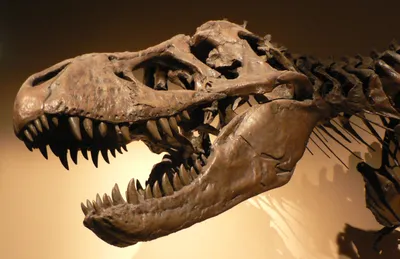
Tyrannosaurus
Of everything here, this is the entry where the fossil record backs the fame. The type species is one of the best represented theropods — some specimens are nearly complete skeletons. Sue (FMNH PR2081), among the largest and most complete, is at the Field Museum of Natural History in Chicago. The most complete specimen measures 12.3–12.4 m (40–41 ft), and most modern estimates allow more than 13 m.
 Tyrannosaurus - Wikipediahttps://en.wikipedia.org/wiki/Tyrannosaurus
 - 5
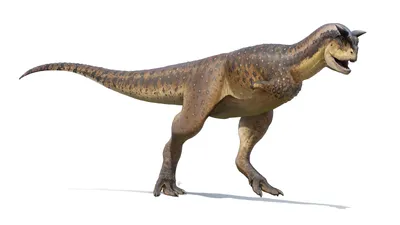
Carnotaurus
Known from a single well-preserved skeleton, which came out of the ground with extensive skin impressions — a mosaic of small, non-overlapping scales roughly 5 mm across. Two thick horns sit above the eyes, a feature unseen in any other carnivorous dinosaur, on a deep skull and a muscular neck. The animal measured 7.5 to 8 m (24.6 to 26.2 ft) and weighed 1.3–2.1 metric tons.
 Carnotaurus - Wikipediahttps://en.wikipedia.org/wiki/Carnotaurus
 - 6
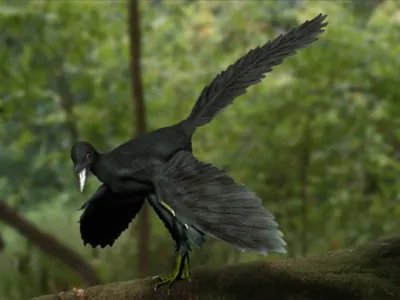
Archaeopteryx
Both things at once — a genus of bird-like dinosaurs, and from the late 19th century into the early 21st the accepted oldest known bird. The type specimen turned up two years after Charles Darwin published On the Origin of Species, in the limestone near Solnhofen, Germany. Body length reached about 50 cm (1 ft 8 in), wingspan about 70 cm, at an estimated 500 to 1,000 grams.
 Archaeopteryx - Wikipediahttps://en.wikipedia.org/wiki/Archaeopteryx
 - 7
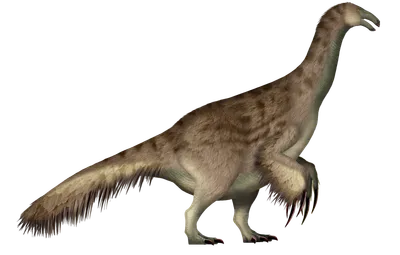
Therizinosaurus
Maleev took the first remains, from a 1948 Mongolian field expedition in the Gobi Desert, for a large turtle-like reptile. The claws explain that — its manual unguals are the longest known of any land animal, reaching above 50 cm (20 in). The animal behind them grew 9–10 m (30–33 ft) long and 4–5 m (13–16 ft) tall, on robust forelimbs carrying three stiffened, elongated fingers.
 Therizinosaurus - Wikipediahttps://en.wikipedia.org/wiki/Therizinosaurus
 - 8
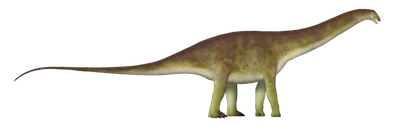
Brontosaurus
The 2015 study that brought this name back came from a joint British-Portuguese research team, which concluded the genus is distinct from Apatosaurus. Not all paleontologists agree, and the lead says the status is still uncertain. B. excelsus, the largest species, measured up to 21–23 m (69–75 ft) and weighed up to 15–20 t — Apatosaurus gives the identical range, which is why one of the two is missing here.
 Brontosaurus - Wikipediahttps://en.wikipedia.org/wiki/Brontosaurus
 - 9
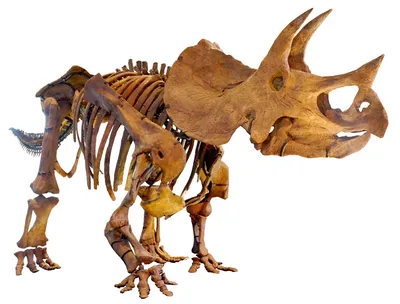
Triceratops
Here the screen version and the skeleton mostly agree: a large bony frill, three horns on the skull, a four-legged body around 8–9 m (26–30 ft) long and 6–10 metric tons. What the fossils add is a growth series — specimens representing life stages from hatchling to adult have been found. What the head adornments were for is still speculated about.
 Triceratops - Wikipediahttps://en.wikipedia.org/wiki/Triceratops
 - 10
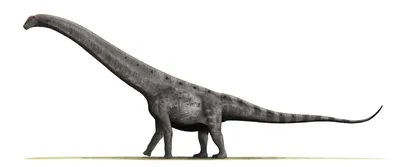
Argentinosaurus
Biggest number on this list, thinnest material behind it. Guillermo Heredia found the first bone on his farm near Plaza Huincul in 1987 and took it for a petrified log. Excavation added, in the article's words, seven dorsal vertebrae and the underside of the sacrum. The lead calls the genus known only from fragmentary remains, then gives 30–35 m (98–115 ft) and 65–80 t.
 Argentinosaurus - Wikipediahttps://en.wikipedia.org/wiki/Argentinosaurus
 - 11
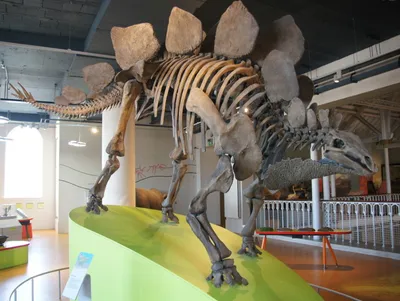
Stegosaurus
Upright plates along the back and spikes on the tail are in the article's first sentence, and almost the whole reputation rides on that outline. S. ungulatus counts among the largest stegosaurians, its biggest known specimens about 7.5 metres (25 ft) long and over 5 metric tons (5.5 short tons). Behind the outline, the braincase was small — no larger than that of a dog.
 Stegosaurus - Wikipediahttps://en.wikipedia.org/wiki/Stegosaurus
 - 12
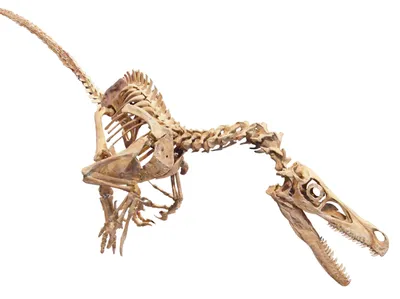
Velociraptor
Its own article does the correction: in reality the animal was roughly the size of a turkey, considerably smaller than the 2 m, 90 kg reptiles of the novels and films. Measured out, it comes to 1.5–2.07 m (4.9–6.8 ft) and 14.1–19.7 kg (31–43 lb). One famous specimen preserves a Velociraptor locked in combat with a Protoceratops — the Fighting Dinosaurs.
 Velociraptor - Wikipediahttps://en.wikipedia.org/wiki/Velociraptor
 - 13
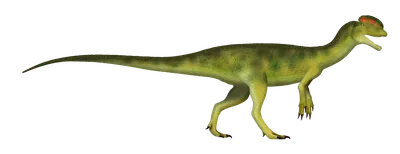
Dilophosaurus
Bottom of the list because the screen version is close to pure invention. The novel and its film adaptation gave it fictional abilities to spit venom and expand a neck frill, and depicted it as smaller than the real animal. The animal itself was about 7 m (23 ft) long and 400 kg (880 lb), with a pair of arched longitudinal crests whose complete shape is unknown.
 Dilophosaurus - Wikipediahttps://en.wikipedia.org/wiki/Dilophosaurus
How this list was ranked
Readers rank this list by voting items up and down. Items are ordered by reader votes.